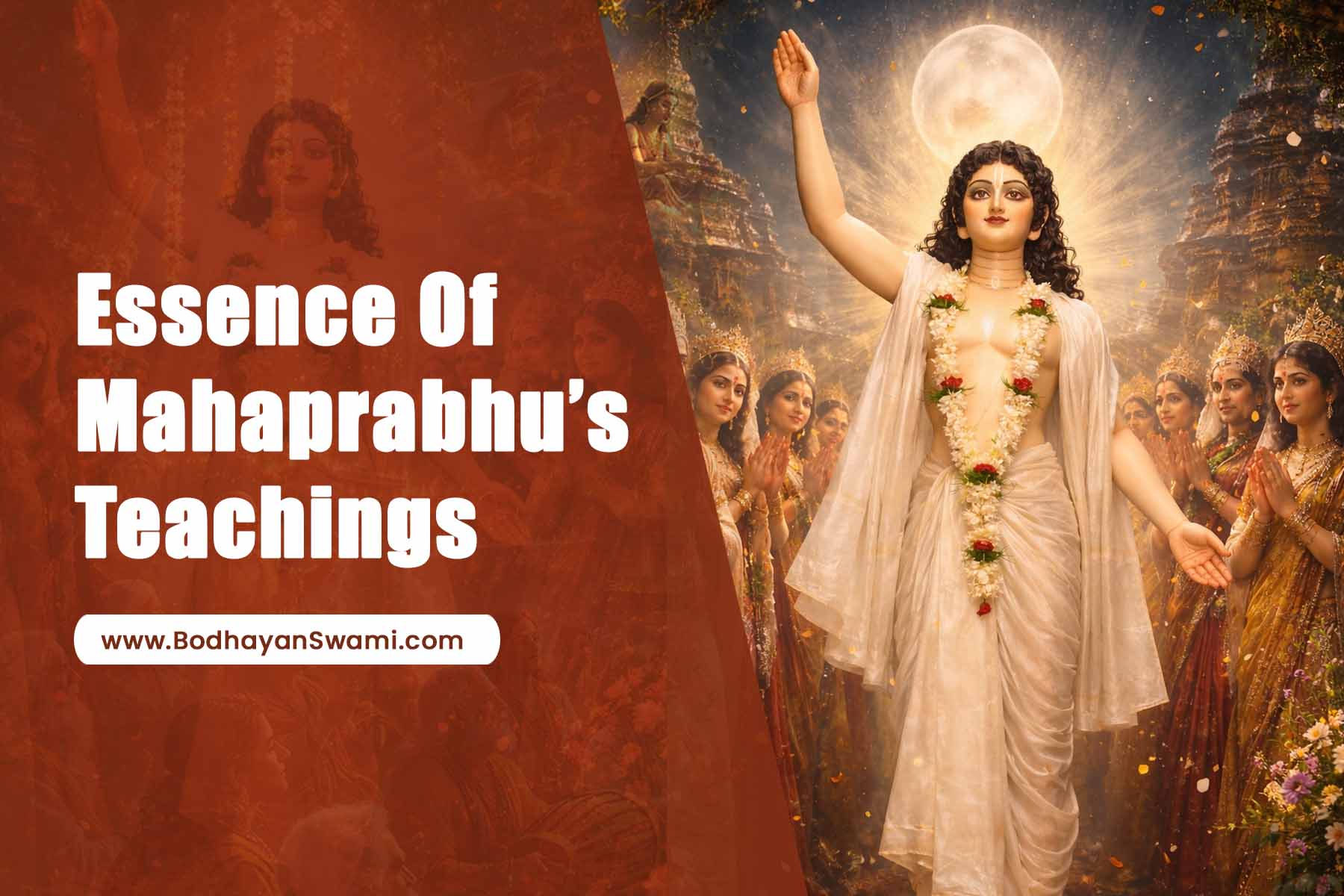
The Essence Of Mahaprabhu’s Teachings
We are currently passing through the 540th year of the Gaura era, which means it has been 540 years since the appearance of Sri Krishna Chaitanya Mahaprabhu. Mahaprabhu appeared in the village of Mayapur, in the Nabadwip area of the Nadia district, in West Bengal, India. This has been described in Bhakti-ratnakaar:
navadvépa mäjhe mäyäpura gräm
yahi avatérëa hoilen gaura bhagavän
There are many names for Mahaprabhu. Some people call Him “Sri Gauranga,” while others refer to Him as “Sri Gaurahari.” The primary teaching of Mahaprabhu is summarized in the third verse of Sikshastakam:
tånäd api sunéchena taror iva sahiñëunä
amäninä mänadena kértaëéyaù sadä hariù
A person who thinks himself lower than grass, who is tolerant like a tree, who does not expect honor from others but gives respect to everyone—such a person is qualified to always chant the Holy Name of Hari.
Srila Bhaktivinode Thakura elaborated on this verse in the following kirtan:
çré-kåñëa-kértane yadi mänasa tohär
parama yatane tahi labha adhikär
If you carefully and constantly engage your mind in glorifying Lord Krishna through the sincere practice of Sri Krishna kirtan, you will gradually gain true spiritual qualification.
tåëädhika héna, déna, akiïcana chär
äpane mänabi sadä chäri ahaìkär
Let go of all artificial pride and consider yourself insignificant. Be free from ego, and be even more humble than a blade of grass.
våkña-sama kñamä-guëa korobi sädhan
pratihiìsä tyaji anye korobi pälan
Cultivate the tolerance of a tree. Renounce any tendency toward harming others, and instead try to care for and support all living beings.
jévana-nirvähe äne udbega nä dibe
para-upakäre nija-sukha päsaribe
As you go through life, do not become the cause of worry or distress for anyone. Rather, work for the welfare of others, setting aside concern for your own comfort.
haileo sarva-guëe guëé mahäçaya
pratishöhäçä chäòi kooa amäné hådaya
Even if you develop noble qualities, you should reject the desire for recognition or praise and keep your heart free from pride.
kåñëa-adhiñöhäna sarva-jébe jäni sadä
korobi sammäna sabe ädare sarvadä
Understanding that Lord Krishna dwells within every living being, consistently treat all with sincere respect and honour.
dainya, dayä, anye mäna, pratiñöhä-varjan
cäri gune guné hoi’ koroha kértan
When a person embraces these four virtues—humility, compassion, honoring others, and abandonment of the longing for prestige—he becomes truly refined. In that purified condition, he is fit to sing the Lord’s glories.
bhakativinoda käïdi, bole prabhu-päy
heno adhikära kabe dibe he ämäy
Weeping, Bhaktivinode submits this prayer at the Lord’s lotus feet: “O Lord, when will You bless me with the eligibility to embody these qualities?”
This kirtan explains the essence of Sri Gauranga Mahaprabhu’s teachings. Mahaprabhu taught that if a person chants Sri Krishna’s Holy Name with great care, fixing the mind fully at the lotus feet of Sri Krishna and His pleasure potency, Srimati Radharani, spiritual qualities will gradually appear in that person.
The only goal of chanting the Hare Krishna Mahamantra is to give pleasure to the Lord. If a practitioner’s heart is filled with material desires, he can never achieve the real result of chanting, which is love for Krishna. If someone chants the Hare Krishna Mahamantra with offences, instead of gaining love for Krishna, material desires for profit, worship, and fame will increase. The stronger one’s material desires are, the more indifferent one becomes toward chanting the Holy Name.
Our previous acharyas compared material prestige to the stool of hogs. The more sincerely we chant the Holy Name under the guidance of the Guru and the Vaishnavas, the more we receive the mercy of the Holy Name.
Sri Chaitanya Mahaprabhu personally instructed Swarup Damodar on the method by which chanting brings love of Krishna:
je rüpe loile näma prema upajaya
tär lakñaëa-çloka çuna, svarüpa-räma räya
O Swarup Damodar and Ramananda Ray, in order to understand how to chant the Holy Name so that divine love awakens, please hear the symptoms of such chanting.
uttama haïa äpanäke mäne tåëädhama
dui-prakäre sahiñëutä kare våkña-sama
Though one may be exalted, he considers himself lower than a blade of grass. In two ways, he practices tolerance, just like a tree.
våkña yena käöileha kichu nä bolaya
çukäïä maileha käre päni nä mägaya
When a tree is cut, it does not protest. Even when it dries up, it does not beg anyone for water.
yei ye mägaye, täre dey äpan-dhana
gharma-våñöi sahe, änera karaye rakñaëa
Whoever asks for it, the tree gives its own wealth. It tolerates heat and rain, while giving shelter and protection to others.
uttama haïä vaiñëava habe nirabhimäna
jéve sammäna dibe jäni’ kåñëa-adhiñöhäna
In this way, though elevated, a Vaishnava remains free from pride. Knowing that Krishna resides within every living being, he offers respect to all.
ei-mato haïä jei kåñëa-näma lay
çré-kåñëa-caraëe täïra prema upajay
Love for Sri Krishna’s lotus feet awakens within the heart of one who chants Krishna’s name in this spirit.
(Chaitanya Charitamrita, Antya-lila 20, 22-26)
Mahaprabhu is teaching us to decorate ourselves with true Vaishnava qualities. Humility is the ornament of a Vaishnava. Without humility, we cannot truly respect others or be tolerant.
Nowadays, many may wear the dress of a Vaishnava, but without humility, they compete for profit, worship, and prestige. They fight and rival each other for recognition. A true Vaishnava never criticizes others. They respect everyone.
Division, criticism, and quarrel among Vaishnavas are not results of chanting the Hare Krishna Mahamantra. The real fruit of chanting is love for Krishna. This love frees us from material attraction and connects us to eternal spiritual joy in Goloka Vrindavan.
The great personality of loving devotion, Srila Narottam Das Thakur, prayed:
golokera prema-dhana, harinäma saìkértana
rati nä janmilo kene täya
The congregational chanting of the Holy Name is the treasure of divine love from Goloka—why has attachment for it not awakened within my heart?
The Hare Krishna Mahamantra has come from Goloka, the eternal abode of divine love, to free us from the quarrelsome nature of Kali yuga and take us back to that spiritual world.
To chant properly, we must become free from offences—especially criticizing Vaishnavas—and give proper respect to everyone. We must refine our speech so that no one feels hurt by our words. ‘präëé matra mano-väkye udvega nä dibe’—we should not cause mental distress to any living being.
My revered Gurudeva, Nitya-lélä-pravishta Om Vishnupada 108 Sri Srimad Bhakti Pramode Puri Goswami Thakura, used to give an example. If someone steals something valuable from us, and we know it is in his pocket, we should not accuse him harshly. Instead, we should politely say that perhaps by mistake the item has gone into his pocket, and kindly request him to return it. In this way, he will feel ashamed rather than hurt, and may even give up stealing in the future.
Vaishnavas always wish well for all living beings. They never harm anyone, even in thought. They are always engaged in the welfare of others.
Mahaprabhu taught:
äpani äcari dharma jévere çikhäya, äpani na koile dharma çikhäno nä jäya
One must practice religiosity oneself before teaching it to others. That is why Vaishnavas do not perform any activity just to entertain others. They always try to engage themselves in pleasing the Lord and His devotees through service.
Srila Krishnadas Kaviraja Goswami composed Chaitanya Charitamrita and Sri Govinda Lilamrita. In his eternal spiritual identity, he is known as Kasturi Manjari. There are eight prominent Manjaris, and he is one of them. She is always engaged in the service of Sri Radha and Sri Krishna.
By the desire of Sri Chaitanya Mahaprabhu, that same Kasturi Manjari appeared in the age of Kali as Krishnadas Kaviraja Goswami. He came to this world to teach us many lessons of devotion. He taught that a Vaishnava is the very embodiment of humility. In very humble words, he openly proclaimed to the world the mercy of Nityananda Prabhu.
jagäi mädhäi haite muïi se päpiñöha
puréñera kéöa haite muïi se laghiñöhaI am more sinful than Jagai and Madhai. I am lower than a worm in stool.
mora näma çune yei tära puëya kñaya
mora näma laya yei tära päpa hayaWhoever hears my name loses his piety. Whoever utters my name becomes sinful.
emana nirghåëa more kebä kåpä kare
eka nityänanda viëu jagat bhitareWho in this world would ever show mercy to someone as fallen as me? No one except Lord Nityananda.
preme matta nityänanda kåpä-avatära
uttama, adhama, kichu nä kare vicäraNityananda, intoxicated with divine love, is the incarnation of mercy. He does not judge who is high or low.
ye äge paòaye, täre karaye nistära
ataeva nistärilä mo-hena duräcäraHe delivers whoever comes before Him. Therefore, He has delivered a wicked person like me.
(Chaitanya Charitamrita, Adi-lila 5.208-9)
In the same spirit of humility, Srila Bhaktivinode Thakura prayed:
sarvasva tomära, caraëe saïpiyä
paòechi tomära ghare
tumi to öhäkura, tomar kukura
baliyä jänaha more
I have surrendered everything at Your lotus feet and taken shelter in Your home. You are my Lord; please accept me as Your dog.
bäïdhiyä nikate, ämäre pälibe
rahiba tomära dväre
pratépa-janere, äsite nä dibo
räkhibo gaòera päre
Keep me close to You and maintain me; I will remain at Your doorway. I will not allow opposing persons to enter, but will keep them outside the gate.
tava nija-jana, prasäda seviyä
ucchiñöa räkhibe yähä
ämar bhojan, parama-änande
prati-dina ha’be tähä
After Your own devotees honor Your prasad, whatever remnants they leave—that will be my food, and I will partake of it daily with great joy.
bosiyä çuiyä, tomära caraëa
cintibo satata ämi
näcite näcite, nikaöe jäibo
jakhona òäkibe tumi
Whether sitting or lying down, I will always meditate on Your feet. Dancing with happiness, I will come near You whenever You call me.
nijera poñana kabhu nä bhävibo,
rohibo bhävera bhore
bhaktivinoda, tomäre pälaka,
boliyä varaëa kore
I will never worry about my own maintenance; I will only remain absorbed in devotion. Bhaktivinode accepts you as his protector and guardian.
The main teaching of Mahaprabhu is that every Vaishnava should become like a faithful dog of the Guru, the Vaishnavas, and Krishna. Only when someone develops the nature of such a dog can they truly be established in the path of Vaishnavism. A dog never cheats its master. It is fully surrendered to its master. That is why even today, wealthy people often feel more secure keeping a dog at their home, office, or factory instead of hiring a guard. A guard might betray the master, but a dog will never betray them. A dog is a faithful servant. In the same way, we must also become faithful servants of God.
The human body is suitable for serving and worshiping Lord Hari. But even after getting this rare human body, those who do not worship the Lord are covered by illusion (mäyä). Due to bad association, they give up devotion and become servants of mäyä. Birth after birth, according to their past actions (karma), they receive different bodies and suffer many kinds of pain and misery in this material world.
But none of us wants to suffer—everyone wants happiness. However, we do not know where true happiness is found. The only true form of joy is Sri Sri Radha Krishna. In this present age of Kali, Radha Krishna have appeared as the Hare Krishna Mahamantra to free us from the world of illusion. If, under the guidance of Guru and Vaishnavas, we wholeheartedly chant the Hare Krishna Mahamantra daily, then our human life will become successful.
My most worshipable Gurudeva, Srila Bhakti Pramode Puri Goswami Thakura, taught us to follow the Vaishnavas and be under their guidance. In 1997, at Sri Gopinath Gaudiya Math in Mayapur, the centenary celebration of Srila Gurudeva was being observed. Nearly a thousand devotees gathered there. On that day, Gurudeva addressed the assembled devotees and said:
“You have gathered here on my birthday, thinking me worthy of honor and worship. But I am not worthy of your worship. My most worshipable Gurudeva Srila Prabhupada Bhakti Siddhanta Saraswati Goswami Thakura, my Parama-Gurudeva Paramahamsa-kula-cudamani Thakura Srila Gaura Kishore Das Babaji Goswami Maharaja, Srila Sacchidananda Bhaktivinode Thakura, and all the previous acharyas are worthy of worship. You have actually gathered to worship them. I am only a pet dog of my Guruvarga.
You know that wealthy people keep foreign dogs in their homes. Those dogs often lie near the feet of their rich master. When someone brings a flower bouquet to honor the master, sometimes a flower falls near the dog’s feet. The dog never thinks that the flower was offered to worship him. In the same way, I do not think that you have come here to worship me.”
Gurudeva spoke these words from deep humility. I have personally seen in his life the result of worship performed with true humility.
In 1990, at Sri Chaitanya Gaudiya Math in Mayapur, Srila Gurudeva observed a complete fast on Gaura Purnima without even drinking water. The next morning, after finishing his daily duties, he sat with his japa beads, chanting the Holy Name. Many householder devotees had gathered to take his darshan before returning home. But Gurudeva was deeply absorbed in chanting and seemed unaware of his surroundings. Everyone thought he was resting and did not want to disturb him, yet, as is customary, they could not leave without his permission.
At that time, Sripad Ananda Gopal Prabhu, a disciple of Srila Bhakti Vilas Tirtha Goswami Maharaja and a neighbor from Gurudeva’s earlier life, arrived. Seeing Gurudeva apparently resting, he loudly called out, “Maharaja!”
Immediately, Gurudeva opened his eyes, saw everyone sitting there, and said, “Ananda Gopal Prabhu, you are here? Please forgive me. What could I do? Srimati Radha Thakurani had engaged me in service at Radha Kunda. That is why you had to wait.”
Hearing this, everyone was astonished. Although Gurudeva was physically present in Mayapur, by the order of Srimati Radha Thakurani, he was engaged in service at Radha Kunda in faraway Vrindavan. This is the result of devotional service performed with humility.
This humility is the ornament of the teachings of Sri Gauranga Mahaprabhu. Without humility, negative qualities such as intolerance, desire for profit, worship, and prestige will arise. The heart will become filled with unwanted things (anarthas). The main goal of our spiritual practice is to become free from these unwanted things and attain divine love (prema).
The essence of Mahaprabhu’s teaching is:
niraparädhe näma loile päya prema-dhana
If one chants the Holy Name without offences, one attains the treasure of divine love.
Today, on this 540th year of Gaura, at the lotus feet of Sri Gauranga Mahaprabhu, with folded hands and deep gratitude, I bow down and humbly pray at the lotus feet of all the devotees. Please shower your causeless mercy upon me. Crush my pride and ego, and grant me the qualification to become humble, which is the ornament of a Vaishnava. Gradually free me from offences so that by chanting the Hare Krishna Mahamantra, I may attain love for Krishna.